Revlon One-Step vs. a Dryer and Round Brush: Which Fits Your Morning?
Compare the Revlon One-Step oval brush with a Conair dryer and separate round brush for bangs, longer layers, and realistic weekday styling.
In this guide
When there are twelve minutes between getting out of the shower and leaving for work, the best styling tool is the one you can reach for without reorganizing your bathroom. A hot-air brush seems like the obvious choice because it puts the brush and airflow in one hand. For shoulder-length layers you want to turn under, that can be the simpler arrangement. For short fringe that dries in the wrong direction while you finish the rest of your routine, a separate dryer with a small brush may be easier to control. The two setups solve different parts of a blowout.
This comparison uses the published design of the original Revlon Salon One-Step Hair Dryer and Volumizer and the Conair InfinitiPRO Frizz-Free Compact Dryer paired with a separate round brush. It focuses on access, technique, storage and how much work each arrangement asks of you. The conclusions are judgments about fit based on their designs. Styling speed and the finished result will depend on your cut, starting moisture and technique.
What the two setups let you control
The original One-Step has a fixed oval head. Its broader faces support a section as you draw the brush along it, and the curved edges give you somewhere to shape the ends. Keeping the air and brush together can be useful if you normally have to set a dryer down to free a hand for sectioning. The compromise is that the head size and airflow position are part of the same design. An oval head that works well on the lengths can feel bulky if the strand you are trying to reach barely extends beyond your fingertips.
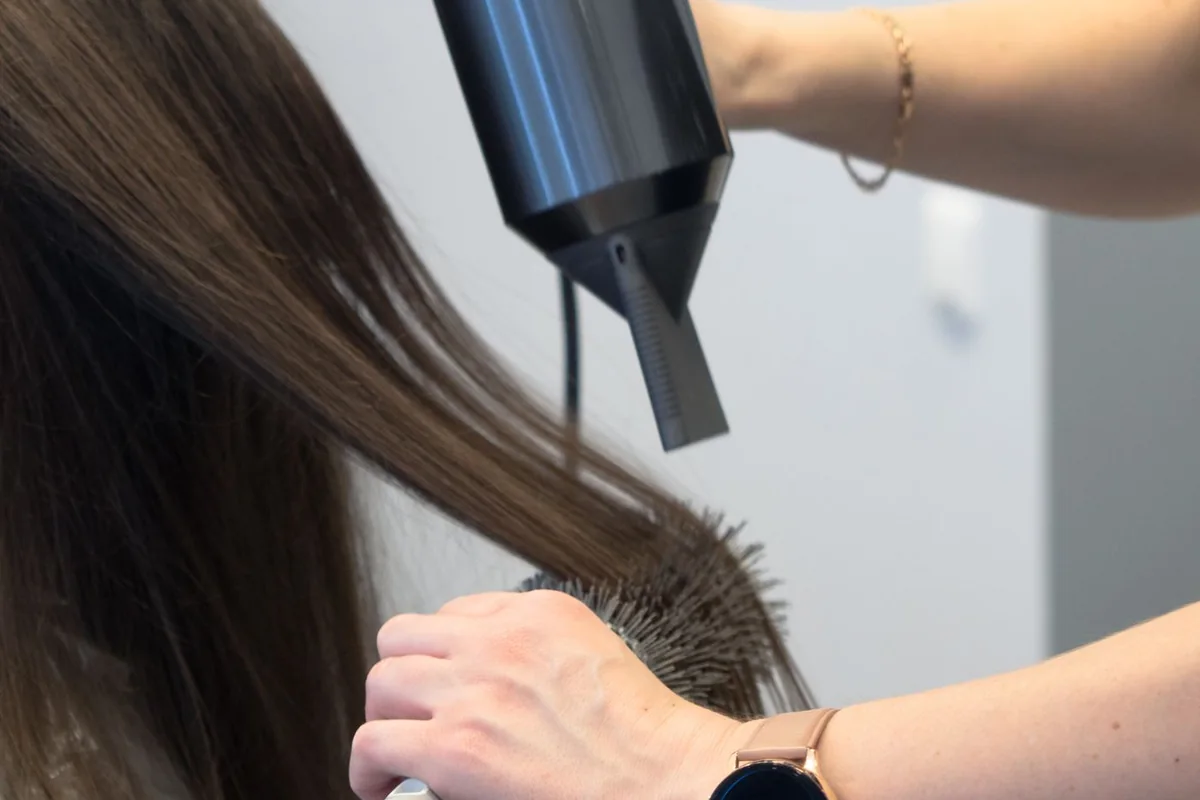
A dryer and separate brush give you two independent controls. You can point the dryer at a fringe while brushing hair to either side, move the airflow away while you reposition the brush, or switch from a small barrel at the front to a larger one for the sides. Conair’s styling instructions for its 650 series dryer describe directing air along the section, which illustrates why a concentrator matters for targeted work. Check the attachments listed for the exact model you buy. An instruction booklet for one dryer family does not establish the box contents of another.
| Routine problem | What helps most | What to check before you buy |
|---|---|---|
| Short fringe dries before you are dressed | Separate dryer with a small brush | Brush barrel fits under the fringe without swallowing it |
| Shoulder-length ends need a gentle bend | Oval hot-air brush | You can guide a small section around an edge and release it cleanly |
| Dense roots are damp while ends are nearly dry | Separate airflow and sectioning | Access to the nape and space to put the brush down |
| You want the same soft finish most weekdays | One integrated tool | Grip feels manageable when you reach behind your head |
Think about the time before styling starts
A common mistake is comparing the time spent with the brush without counting the time needed to get your hair ready for it. On a rushed morning, heavy sections may still be very wet beneath the surface even when the outer layer feels ready. If you spend the whole session trying to dry the back with the brush, the shorter routine you expected disappears. A separate dryer can be useful for taking care of this early stage, even if you later switch to an integrated brush to shape the sides.
Try measuring the job once with the tools you own. Blot out excess water, then divide the hair into a front section, two sides and the back. Notice which area still needs work when the others are ready to shape. If your main frustration is coordinating two tools at the same time, a hot-air brush solves a real problem. If your time goes into getting the roots and nape dry enough to style, solve that part first. Buying a second heat tool may give you another step without changing the long one.
A weekend test can also show whether you need all the sections to be polished. If you usually wear your hair back by lunchtime, shape the front and the ends you can see when you tie it. The saved time might be more valuable than a full finish that lasts only until you step outside.
Which is better for bangs, layers and longer hair?
For a short or divided fringe, use a smaller tool than you would choose for your overall blowout. With separate airflow, you can work the hair from side to side before directing it into its final position. If a large barrel cannot catch your fringe without the head touching your face, you are buying the wrong shape for that job. You could still use it on your lengths, but plan for a different way to handle the front. If those strands are your only styling priority, keep the dryer and spend on a smaller brush only if the one you own cannot reach them.
Layers around the chin or shoulders offer more length for an oval head to work with. If the front sections are roughly the same length and you want the ends to bend in a consistent direction, the integrated brush can feel more intuitive. Work in sections small enough to lie smoothly against the head. Winding up too much hair at once can make it difficult to release, especially around shorter layers. A dryer and brush remain more adaptable if you change the direction of individual pieces or want the front to fall differently from the back.
For long, dense hair, reach matters at least as much as head width. A wide brush may cover more surface yet still struggle to reach into a tightly held bundle. Smaller sections make it easier to see and feel what remains damp. You also have to lift the full handle and brush whenever you need to re-angle the One-Step. Before ordering, picture using it near the back of your head with your elbow raised. At a store, practice the motion with an unplugged display tool if one is available. The relevant difference is how the grip feels while you move, not how manageable it seems sitting on a shelf.
The storage and travel tradeoff
A one-tool setup frees up a hand, but a fixed oval head does not necessarily save drawer space. Take the drawer depth with the cord loosely arranged, and leave room for the head to cool before putting it away. If you share the bathroom, a tool that needs to sit on the counter after styling may be less convenient than two compact items you can store separately. Consider where the cord will run, too. A short reach from outlet to mirror can make it hard to use the same grip on both sides.
For an overnight bag, choose by the service you need at the destination. If a hotel already supplies a dryer and you only need to turn your fringe under, your small round brush takes up less space. If the hotel dryer is awkward for your routine and you use your hot-air brush on most wash days, bringing the full tool can make sense. For international travel, check the model label and manufacturer instructions for voltage compatibility before packing. A plug adapter and voltage conversion are different things.
What to buy first
Keep your current dryer if it works and you know exactly which part of the routine you want to improve. Try a different brush diameter, a concentrator that matches the dryer, or a smaller number of sections first. Buy the One-Step if the hardest part of your weekday blowout is holding both tools in sync and you mainly style hair long enough to engage the oval head. Keep the dryer-and-round-brush setup if you spend more time on short face-framing pieces, work through damp roots, or use different brush sizes for different sections. That decision is more useful than choosing by wattage or by the promise of a one-step finish.